Latest News
W. W. Norton & Company: Evelyn in Transit by Dave Guterson
WHAT TO READ NEXT: REVIEWS OF GREAT BOOKS

As part of my job, I grab books well before their publication. I read many right away, but some float around for years, from my desk to my bag, onto an end table, over to a bookshelf, out to the couch, and back to a shelf, all before I actually take a real look. Either I read something six months before it comes out or 10 years after the fact. But it's all part of a rhythm.

A colleague of mine recommends reading a mystery after finishing a particularly potent story, when you feel like nothing else can hold a candle. That's also when I'll reach for one of those books that have followed me around for years and years. Or, I'll pull out a classic, some gem that's really stood the test of time. As a result, I've developed a reliable fondness for Michael Bennett's riveting Hana Westerman thrillers, Katherine Heiny's breathtaking short stories, and Edith Wharton's spellbinding novels. Although, I must admit, that the palate cleanser is often just as satiating as the main course.

--Dave Wheeler, senior editor, Shelf Awareness
FEATURED TITLES
Cover

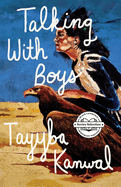
Talking with Boys

Tayyba Kanwal

Tayyba Kanwal's superb debut collection features 15 interwoven stories with peripatetic global characters searching for new ways to inhabit their stagnant lives.
Cover

Talking with Boys

Tayyba Kanwal

Black Lawrence | $17.95 | 9781625571793

Author/editor Tayyba Kanwal's stellar Talking with Boys crisscrosses Houston, Dubai, and Lahore (and nearby surrounds) over seven decades in 15 intriguingly linked stories centering mostly Muslim characters searching out, albeit not always finding, other options for how to live less stagnant lives. While each story easily stands alone, connecting various narrative threads, of course, provides additional satisfaction.

"The Girl Who Ran" opens in 2015 Houston when high school senior Amal defies traditional expectations and marries university student Zee, "the boy her family had forbidden her from seeing"--then leaves him when his mother offers her a different future. "Talking with Boys" spotlights Mariam, who is dating Amal's brother, and her complicated relationship with her younger sister. "Mehr" introduces a Pakistani teen whose burqa allows her to disappear and escape the fate of early marriage embraced by her cousin Shama, who returns as a new immigrant to Houston with a young daughter, Zoya, in "A Shade for the Window." Zoya ends the collection in "Bungalow" as a mathematician buying her first home.

Houston-based Pakistani American Kanwal's debut was deservedly designated Black Lawrence Immigration Series' 2024 selection. She distinguishes her fiction by deftly showcasing global migrations rather than limiting her characters to U.S.-based aspirations. The interwoven stories based in Dubai disturbingly expose the myriad of abuses by privileged residents on their migrant staff. Arrival to a destination, Kanwal posits, offers no guarantee--some might choose to return home, others might forcibly be removed. Welcome can never be expected. Writing in straightforward prose infused with meticulous insight, Kanwal presents notable characters commanding attention and inspiring lingering empathy. --Terry Hong

Cover

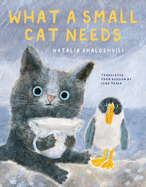
What a Small Cat Needs

Natalia Shaloshvili, trans. by Lena Traer

Natalia Shaloshvili's inviting picture book whimsically captures a small cat's many needs--milk, a flower patch, a window--but what she needs most is that special someone with a big heart.
Cover

What a Small Cat Needs

Natalia Shaloshvili, trans. by Lena Traer

Enchanted Lion | $17.99 | 9781592704774

Of course, ailurophiles (cat lovers) are the perfect audience for author/artist Natalia Shaloshvili's enchantingly whimsical picture book, What a Small Cat Needs, but it's also likely to attract anyone and everyone who opens their hearts to animals. As in Miss Leoparda, Shaloshvili's text is once again smoothly translated from the original Russian by Lena Traer.

"What does a small cat need?" Shaloshvili queries. Her furry protagonist here has two small eyes, two small ears, four small paws, and "a body, with spots on her back." She also needs a tail--"even a small one"--to lure a fish, as well as "small pointy teeth" to catch a mouse to feed the "big hunger in her belly." When she can't hold on to her catch, her hungry belly will need milk. Afterward, she'll need sunlight "to warm her furry belly." Most of all, when darkness falls and she "feel[s] a bit scared," she'll need a door where she can wait for that special "someone to walk in." That someone just needs "a big heart and warm hands" for purring snuggles. "Because every cat--big and small--needs that very much." Everyone does.

Shaloshvili creates dreamy, welcoming spreads, capturing a heartwarming softness that avoids sharp angles and dividing lines. She favors a blue-scale palette with bright pops of orange and yellow (and the tiny pink triangular kitty nose), creating inviting, multilayered textures. When the kitty's human arrives home--nose and ears flushed from just having come in from the cold--their matching eyes are immediately noticeable, suggesting a forever promise to provide everything a small cat will ever need. --Terry Hong

Little, Brown Ink: Ghost Boys: The Graphic Novel by Jewell Parker Rhodes, illustrated by Setor Fiadzigbey
Cover

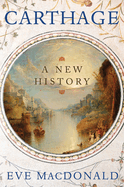
Carthage: A New History

Eve MacDonald

This superb, nuanced history of the ancient civilization of Carthage relies less on Roman accounts and more on DNA and archeological evidence to center Carthaginian people, culture, and impact.
Cover

Carthage: A New History

Eve MacDonald

W.W. Norton | $39.99 | 9781324123279

Eve MacDonald's enthralling Carthage: A New History employs archeology and scientific evidence to tell the fullest story yet of the mighty African empire's rise and fall.

The old maxim that history is written by the victors is never truer than in the case of Carthage, which was defeated and destroyed by the Romans in the Third Punic War; what is known of Carthage and its customs comes chiefly from Roman historians. Using revelations from recent archeological excavations and DNA analysis, MacDonald seeks to "fill in the gaps" to reveal a vibrant, pious, and multicultural society with vast trade networks across the Mediterranean. With an eye toward understanding the practice from the Carthaginian perspective, MacDonald grapples with the evidence of infant sacrifice, long expounded on by ancient historians to prove the barbarity of the Carthaginians. She offers another lens to view the decades-long Punic Wars that refutes the myths Roman writers crafted to justify Rome's destruction of Carthage. By claiming the prominent father and son statesmen Hamilcar and Hannibal Barca were motivated by a "personal vendetta" fueled by their indiscriminate hatred of Rome, these authors reduced "Mediterranean-wide geopolitics to the story of one family." The battles are all here, from Alalia to Zama, and analysis of their main characters is pithy and precise: the war general Hannibal's "aura of power... was the most essential part of his survival."

Full of fresh insights, Carthage is a brilliant and accessible recentering of this ancient civilization and its dynamic contributions to the legacy of the Western world. --Peggy Kurkowski, freelance book reviewer in Denver

Cover

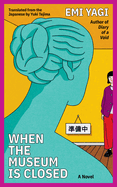
When the Museum Is Closed

Emi Yagi, trans. by Yuki Tejima

Emi Yagi's sophomore novel is another surreal delight, centering on meetings between the goddess of love and beauty and her part-time conversationalist.
Cover

When the Museum Is Closed

Emi Yagi, trans. by Yuki Tejima

Soft Skull | $18.95 | 9781593768270

Emi Yagi, who won Japan's coveted Osamu Dazai Prize with Diary of a Void, returns with another delightfully surreal novel, When the Museum Is Closed. Yuki Tejima smoothly translates, capturing Yagi's impressively matter-of-fact tone as inexplicably zany events continue to happen with unquestioning, quotidian ease.

Rika Horauchi is starting her new job: She's "been hired to talk to the ancient Roman statue of Venus" in the octagonal room of the titular museum every Monday, when doors are closed to the public. Despite Rika's initial hesitation, Venus is quite engaging, bitingly funny, and surprisingly accommodating. And despite the distraction of "her lush body curved to perfection," conversations with the goddess of love and beauty grow easier, especially since Venus "never [runs] out of memories." Rika, too, opens up, and over cups of tea (the one in front of Venus untouched), statue and human share endless stories.

Since childhood, "a ridiculous yellow raincoat" has hampered Rika's life. No one else can see it, but it weighs her down, trips her up, turns into a "sauna suit" causing heat rashes; avoidance and isolation are her best defense. Becoming intimate with a marble statue, however, proves a transformative experience.

Yagi has written a whimsical tale highlighting unexpected relationships--particularly those where one is finally seen and heard honestly, regardless of whether as a coveted goddess or ostracized human. As a slim novella, When the Museum Is Closed might seem initially spare but it's rife with insights on language, communication, love, identity, definitions of beauty, gender roles, and the possibility of true individual freedom. --Terry Hong

Loyola Press: Our Treasures Within by Pope Francis, Peter H Reynolds, and Paul A Reynolds
BOOK REVIEWS
Cover
This twisty thriller full of Russian spies, U.S. government agents, and amateurs who can't help but stumble into the action brings nonstop laughs.
Cover

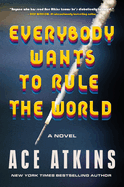
Everybody Wants to Rule the World

Ace Atkins

Morrow | $30 | 9780063293441

In Ace Atkins's rollicking adventure, Everybody Wants to Rule the World, a scheme by Russian spies brings together a once-famous crime writer, a teenager who suspects his mother's new boyfriend is a KGB agent, and an FBI agent investigating the murder of an employee at Scientific Atlanta who had access to top-secret information.

In 1985 Atlanta, Ga., Peter knows there's something funny about Gary, his mother's boyfriend. He has a hard-to-place accent and both a gun and a cassette of Russian music in his car. Peter's mother works for a company with Department of Defense contracts, and Peter thinks Gary is a spy. He approaches Dennis X. Hotchner, who recently wrote a magazine piece about KGB spies, to ask him for help. Dennis initially refuses to buy it, but after prodding from his former-defensive-end-turned-drag-queen friend, Jackie, and events that suggest Peter is in genuine danger, the author and the Tina Turner impersonator join in, becoming embroiled in an FBI investigation that leads to a nest of Soviet agents and double agents.

Atkins (The Sinners; The Innocents) weaves a splendidly intricate web of intersecting plots that is as successful for its comedy as for its nonstop action. Nearly every chapter contains the sort of well-played surprise that feels inevitable as soon as it is revealed, and delightfully funny dialogue ensures that nobody thinks the over-the-top antics are meant to be taken too seriously. Fans of Carl Hiaasen's and Dave Barry's thrillers should look a little further north from Florida to experience Everybody Wants to Rule the World. --Kristen Allen-Vogel, information services librarian at Dayton Metro Library

Cover
A return to an isolated cabin sets a woman dangerously off balance in Hemlock, an otherworldly exploration of addiction, sexuality, and family history.
Cover

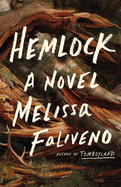
Hemlock

Melissa Faliveno

Little, Brown | $29 | 9780316588195

A return to her family's isolated cabin in the woods of Wisconsin leaves a woman unmoored and profoundly altered in Hemlock, a queer rural gothic exploration of addiction and heritage by Melissa Faliveno (Tomboyland).

Sam plans to fix up the cabin, named Hemlock by her father, and make a quick sale of it. She has a cat and a long-term boyfriend in Brooklyn, and she told them both she'd be gone only a couple of weeks. But a dusty six-pack she discovers in the cabin's basement puts an end to 10 months of sobriety, and while she sits on the porch one evening, a doe speaks to her in the voice of her vanished mother.

Using the remote landscape to its full potential and embracing the equally threatening and comforting possibilities of country life, Faliveno creates an air of menace and instability as Sam seems to simultaneously find and lose herself. Far from her straight-passing life, her body begins to change, becoming something more androgynous or possibly feral. Her sense of time begins to slip, and maybe her sense of reality does too, filling the novel with a dreamlike quality that leaves open the questions of what is real and what is hallucination. By returning to her roots, Sam may discover who she is meant to be or find herself doomed to repeat her mother's fate. Her battles with sinister forces, internal and external, are a powerful depiction of the struggle to escape the generational cycles of addiction that ground Hemlock's eerie sense of the uncanny. --Kristen Allen-Vogel, information services librarian at Dayton Metro Library

Cover
This propulsive debut novel from a former reality television contestant and industry insider celebrates and skewers the genre.
Cover

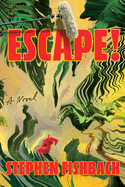
Escape!

Stephen Fishbach

Dutton | $30 | 9798217048151

The personal and professional experiences of a two-time Survivor player and television-industry insider are on full display in Stephen Fishbach's Escape!, a debut novel that explores the driving forces behind reality show contestants and the producers who manage them.

In a new reality show that promises to push the envelope like never before, eight contestants will live in a jungle on an island, subject to limited rules and competing to win keys that will unlock unburied treasure. Among them is Kent, who is middle-aged, depressed, experiencing a break-up, and longing for his glory days on a previous survival-based reality show. Miriam is a pharmaceutical marketing professional mistaken for a chemist, throwing caution to the wind for what was pitched as a grand adventure. On the other side of the island, Beck lives in production housing. As a producer who gained an infamous reputation for always getting the shot even as tragedy unfolds, she's desperate to reclaim the narrative of her career, even if that means influencing the contestants' relationships and actions to a degree that begins moving the production needle from unscripted to scripted.

As each player's established stereotype--the nerd, the villain, the hot girl, the has-been--begins to play out, their choices become more and more frantic, building toward a conclusion that feels inevitable and preventable. Propulsive and affecting, Escape! is a love letter to and indictment of the reality television ecosystem, inside and out. --Kristen Coates, editor and freelance reviewer

Cover
In this suspense-fueled drama, a same-sex couple living in Ohio undergo a terrible ordeal that tests their marriage as well as one partner's sense of belonging in the U.S.
Cover

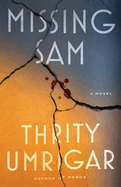
Missing Sam

Thrity Umrigar

Algonquin | $29 | 9781643757629

An interior designer comes under suspicion when her wife suddenly vanishes in Thrity Umrigar's suspense-fueled 12th novel, Missing Sam. The titular character is a professor who goes out on a run one morning and doesn't come home. This begins a horrible nightmare that will test not only the marriage at the novel's heart but also one partner's sense of belonging in the United States.

Settled into cozy domesticity in Ohio's Cleveland Heights, Sam and Ali have endured their share of unwanted attention over their same-sex marriage. Ali's Muslim Indian heritage adds another layer of complexity, especially when Sam's disappearance prompts one of her students to accuse Ali of foul play. That's all it takes for Facebook to erupt with conspiracy theories, Ali's otherness a perfect target for a community desperately seeking answers. As the investigation into Sam's whereabouts gains steam, it reveals uncomfortable details about her marriage to Ali, including their terrible row the night before Sam disappeared. An already distraught Ali is unsettled by the virulent social media campaign against her as Sam's absence drags on. Even if Sam is found, how will the couple recover from their respective ordeals?

Umrigar (The Secrets Between UsEverybody's Son) navigates that harrowing question in this marvelous novel. A phenomenal storyteller, she expertly incorporates thematic layers into the narrative, including family estrangement, racial identity, and psychological trauma. Missing Sam is equal parts a compulsively readable thriller and a beautifully rendered love story that captures how Sam and Ali's different backgrounds are in fact the source of their strength. --Shahina Piyarali

Cover
Former Reykjavík police detective Konrád continues to fail at retirement in this skillfully plotted and soulful crime novel centered on his search for a murdered woman's adult child.
Cover

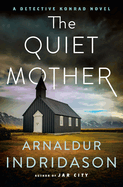
The Quiet Mother

Arnaldur Indriðason

Minotaur | $29 | 9781250403766

Former Reykjavík police detective Konrád continues to fail at retirement in Icelandic crime fiction titan Arnaldur Indriðason's The Quiet Mother, translated by Philip Roughton. Indriðason (The Darkness Knows; The Girl by the Bridge) has skillfully plotted another soulful vehicle for the mononymous Konrád, whose professional determination, as ever, twines with a personal objective.

The novel opens with the murder of the elderly Valborg in the apartment where she lived alone. The detective who arrives on the scene, Marta, spots among the notes on Valborg's desk "a phone number that she knew well" and calls it. Konrád answers and explains that he met the victim two months earlier: she contacted him after reading about one of his celebrated cases. Valborg told Konrád that she was getting her affairs in order because she was terminally ill and wanted his help finding the child she gave up decades earlier. Konrád's guilt over his refusal to help the now-dead Valborg animates his headlong search for her adult child.

The Quiet Mother's roving perspective accommodates Konrád; Marta, who finds his intrusiveness into her murder case exasperating; and Konrád's friend Eygló, who conducts her own investigation into a matter that knocks into his. Once again, Indriðason's readers should come prepared for coincidence as a plot device and also for the foregrounding of a social issue, in this case reproductive rights. While Konrád hunts for the dead woman's child, he continues to pursue the truth about his miscreant father's murder, which readers will understand is also the reluctant retiree's search for himself. --Nell Beram, author and freelance writer

Cover
This witty, empathetic second installment in a cozy mystery series about an organization that deals in death follows a sister determined to save her twin from his scheduled demise.
Cover

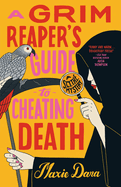
A Grim Reaper's Guide to Cheating Death

Maxie Dara

Berkley | $19 | 9780593815816

In her debut mystery, A Grim Reaper's Guide to Catching a Killer, Maxie Dara introduced readers to S.C.Y.T.H.E. (Secure Collection, Yielding, Transport, and Handling of Essences), an organization of grim reapers who tidy up souls after death. The series' second installment, A Grim Reaper's Guide to Cheating Death, focuses on Nora Bird, a S.C.Y.T.H.E case administrator who assigns daily death files to grim reapers for soul collection. Nora has been terrified of death since losing her parents as a child, which counterintuitively makes S.C.Y.T.H.E. the perfect job for her: she can learn the many ways death occurs and structure her life to avoid them.

Nora's routine is insular and risk averse until the morning she opens a case file and sees that her twin brother, Charlie, is scheduled for death that day. With uncharacteristic disregard for her employer's rules, Nora steals the file and rushes to collect Charlie (and his chatty parrot, Jessica), determined to keep him alive at any cost by getting him somewhere S.C.Y.T.H.E can't reach. Their efforts to avoid the file's now constantly changing cause of death take them to the remote town where their father grew up, which holds odd people and family secrets--and someone who is trying to kill Charlie. With wit and empathy, Dara's cozy sequel is a pitch-perfect mix of charm and emotional depth that reiterates the importance of living every day not without fear of death but in spite of it. --Kristen Coates, editor and freelance reviewer

Cover
Between its first fiery hookup and its final declaration of love, Marissa Marr's Greta Gets the Girl offers passionate bedroom scenes as well as romantic, honest communication.
Cover

Greta Gets the Girl

Melissa Marr

Bramble | $19.99 | 9781250364869

With Greta Gets the Girl, Melissa Marr (Remedial Magic) delivers another steamy contemporary romantic comedy. "Lee" and "Marie" meet on an exclusive lesbian hookup app and believe their connection will end after their one-night stand (okay, it's two nights). After all, they don't use their real names, they meet at a hotel, they don't live in the same city, and neither wants a relationship. When Kaelee travels to New York to finally meet the editor of her debut sapphic novel, she comes face to face with the formerly anonymous hookup she couldn't get out of her mind. Both women realize that their simple yet electrifying fling now risks bleeding into their professional lives and that their connection could cloud the legitimacy of the book release.

Greta Gets the Girl is capital-S Sexy but also packs a strong emotional punch. Kaelee and Greta show all the signs of people falling hard for each other despite a determination to stay single. The women demonstrate maturity as they navigate their growing interest with clear, honest communication and respected boundaries.

Second in a series, Greta Gets the Girl heavily features the lead characters from the previous installment, Toni and Addie Go Viral, so readers will appreciate reading them together. Nonetheless, Greta and Kaelee's charm makes their story enjoyable as a stand-alone as well. Full of heart and heat, Greta Gets the Girl is sure to please any reader who enjoys watching relationships bloom unexpectedly. --Alyssa Parssinen, freelance reviewer and former bookseller

Cover
This detailed biography of legendary singer, songwriter, and performer Dolly Parton traces her life from her impoverished Tennessee roots to fame, fortune, and philanthropy.
Cover

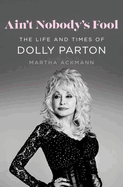
Ain't Nobody's Fool: The Life and Times of Dolly Parton

Martha Ackmann

St. Martin's Press | $30 | 9781250286857

"I remember every little thing about every little thing," Dolly Parton once noted, referring to her songs' vibrant images. In the exhaustive biography Ain't Nobody's Fool, Martha Ackmann (These Fevered Days) follows the icon's lead, sharing copious details of her life from her impoverished childhood to her legendary music and performance career.

With quotations, research, and anecdotes starting from Parton's Tennessee roots, Ackmann presents a touching and honest portrait of the multifaceted artist. Though Parton found fame as a singer, she knew she was part of a music business, and her talents in that area helped her become a multimillionaire. She rebranded a theme park near her childhood home as Dollywood, remaking the local economy in the process, and founded the Imagination Library, which has mailed more than 264 million free books to children since 1995. She wisely kept the publishing rights to her songs, and "I Will Always Love You" earned millions in royalties after Whitney Houston's award-winning hit. The poignant history of that song resonates: Parton sang it with a sometimes cantankerous early mentor, Nashville performer and producer Porter Wagoner, at the Grand Ole Opry shortly before he died.

When Parton boarded a Nashville-bound bus the day after graduating from Sevier County High School, she launched a 60-year career that includes a who's who of musicians and actors, as well as numerous honors. And it's those Tennessee roots that helped her at every turn. "My truest gift," she notes, "is that sound that comes from the mountains." Fans of Dolly Parton--as beloved performer or successful businesswoman--will rejoice in this entertaining biography of the near-octogenarian from the Smoky Mountains. --Cheryl McKeon, Book House of Stuyvesant Plaza, Albany, N.Y.

Cover
Historian Susan Wise Bauer offers a fast-paced survey of sickness and humanity's search for its causes and cures.
Cover

The Great Shadow: A History of How Sickness Shapes What We Do, Think, Believe, and Buy

Susan Wise Bauer

St. Martin's Press | $30 | 9781250272911

Susan Wise Bauer's The Great Shadow is an informative and lively survey of the history of illness and of humanity's attempts to combat it. Though much of her account traces the progress that's been made from times when sickness was thought to be a punishment from angry gods, and when society was essentially helpless to fight deadly diseases, embedded in that story is a serious cautionary tale that will temper one's enthusiasm for the belief that medicine can cure what ails us.

Bauer (The Story of Western Science), who holds a PhD in American Studies, is a fluid writer who brings to this project the useful background of an intelligent, curious generalist. The Great Shadow proceeds in roughly chronological fashion, launching most chapters with attention-grabbing stories--like a description of Edward Jenner's daring first smallpox vaccination--to set the stage for a discussion of broader developments in science and medicine.

The task of recounting the history of more than 12 millennia of humanity's struggle with serious illness and death, including terrifying stories of pandemics that outstrip Covid-19 by many orders of magnitude, is daunting, but Bauer handles it skillfully. If she had written her book 50 years ago, it almost certainly would have ended on a note of triumph. But in her concluding chapter, Bauer delves into the rise of a new category of antibiotic-resistant infections, and the many disconcerting responses to the Covid-19 pandemic and how it mirrored those of earlier, far less enlightened eras. The Great Shadow will help anyone gain perspective on some of the critical public health challenges of the 21st century. --Harvey Freedenberg, freelance reviewer

Cover
A runaway assumes the identity of a missing teen, then realizes his perfect new family may have had something to do with the disappearance in this frightening, suspenseful queer YA thriller.
Cover

Better the Devil

Erik J. Brown

Storytide | $19.99 | 9780063338326

In the unsettling YA psychological thriller Better the Devil by Erik J. Brown (All That's Left in the World) a gay teen escaping the threat of conversion therapy assumes the identity of a missing boy, only to discover that the boy's family might be responsible for his disappearance.

Eight months ago, the 16-year-old narrator ran away from his staunchly Christian parents when they signed him up for conversion therapy. Now, the police have apprehended him for stealing food and, desperate to hide his identity, the narrator gives his name as Nate Beaumont, a boy who went missing almost a decade prior. The Beaumonts readily welcome "Nate" home. Although the narrator wars with guilt, he is deeply fulfilled by how Nate's family cares for him. He also befriends Miles, Nate's distractingly cute childhood friend, who tells him to drop the act. Miles runs a "highly unpopular true crime podcast" about Nate's disappearance and promises to keep the narrator's secret if "Nate" gets intel on the Beaumonts; Miles thinks one of them murdered Nate. Suddenly, "Nate" must investigate a temperamental dad, a super protective mom, and a sweet-and-sour older brother, all while someone frames him for incriminating acts--broken glass in food, a gas leak--that earn him the scrutiny of a potentially deadly family.

This addictively engrossing mystery blends unrelenting suspense with a genuinely heartfelt found family story. The "constant state of fear" that "Nate" lives in is tempered by adorable banter with Miles and quintessential family moments. That gentleness--from a family who may have killed one of their own--adds a deliriously disorienting atmosphere to this brilliant thriller. --Samantha Zaboski, freelance editor and reviewer

Cover
This contemporary YA novel is a sharply comedic take on high school mean girl drama from a modern, queer perspective.
Cover

Freddie and Stella Got Hot

Maggie Horne

Feiwel & Friends | $19.99 | 9781250377371

The friendship drama of Mean Girls meets the chaotic gay energy of Bottoms in Maggie Horne's wickedly funny contemporary young adult novel Freddie and Stella Got Hot.

Freddie, Stella, and Levi "were a solid unit... obsessed with each other" while attending their bougie private middle school. But when they got to Coral Cove, an even "bougier private" all-girls high school, Levi left Freddie and Stella behind. As homecoming queen and the school's "lesbian teen Jesus," Levi is on track to win the prestigious Beaumont-Gardiner Award, which offers the recipient "a full-ride scholarship to the school of their choice." Freddie and Stella know that if Levi doesn't win the BG, "it would crush her." But Stella wants revenge and convinces Freddie to join her in trying to get the BG themselves. There's only one problem: "the girls who win the BG are... invariably, inevitably, consistently hot." Freddie and Stella hatch a plan to get hot ("hot girls work out," "hot girls do brunch," and "hot girls help their community"). As the girls work toward their goal, Stella becomes increasingly power-hungry, and Freddie realizes she might need Levi to stop this newly born "supervillain mastermind."

Author Horne (Don't Let It Break Your Heart) revels in the messiness of the novel's scheming, sharp-tongued protagonists: "California girls with new-money parents" who are "bored and unsupervised," but "sad underneath it all." Freddie's self-conscious and sarcastic narration of her evolution from Stella's "quirky sidekick" to a young woman pursuing her own desires--including Levi--hits all the satisfying notes of a coming-of-age comedy. Fans of Casey McQuiston and Dalhia Adler should enjoy this banter-filled romp. --Alanna Felton, freelance reviewer

Cover
This melodic, transportive middle-grade novel-in-verse adeptly depicts the harrowing experience of Chinese Americans in 1880s California.
Cover

Eureka

Victoria Chang

Farrar, Straus and Giroux | $18.99 | 9780374393533

In Eureka, a melodic, transportive middle-grade novel-in-verse, Victoria Chang (Love, Love) adeptly depicts the harrowing experience of Chinese Americans in 1880s California.

It's November 1884, and violence and racism against Chinese people is rising in San Francisco. "You/ must/ go," 12-year-old Mei Mei is told by her parents, who worry the brokers to whom they owe money will kidnap Mei Mei and sell her into slavery. In San Francisco, Mei Mei isn't allowed to attend school "with the American kids," but when her parents send her north to live with family in Eureka, they tell her a "judge just said/ schools must let Chinese/ kids... go to school with/ the white kids." Instead, when Mei Mei arrives, she's ushered to a rich white family's house, and every day, she's "cutting vegetables./ Rolling dough./ Mixing flour./ Stirring soups./ Cleaning the floor./ Repeat." Mei Mei is ecstatic when the daughter of the house offers to secretly teach her to read English, but anti-Chinese sentiment increases in Eureka and threatens to dash Mei Mei's hopes.

Chang effortlessly employs her poetic prowess to tell a well-balanced story of childhood innocence and horrible acts. Her enticing formatting renders beautiful visuals (such as Mei Mei's mother's tears forming a teardrop) and evokes strong emotional responses. Chang's word choices express lovely imagery: "Her words flood out/ like a river and I am/ just a boat floating." Themes of freedom, found family, and hope are all featured in this heartbreaking yet stirring story of survival. Back matter includes an author's note about the Chinese Exclusion Act, cultural facts, and additional resources. --Lana Barnes, freelance reviewer and proofreader

The Writer's Life

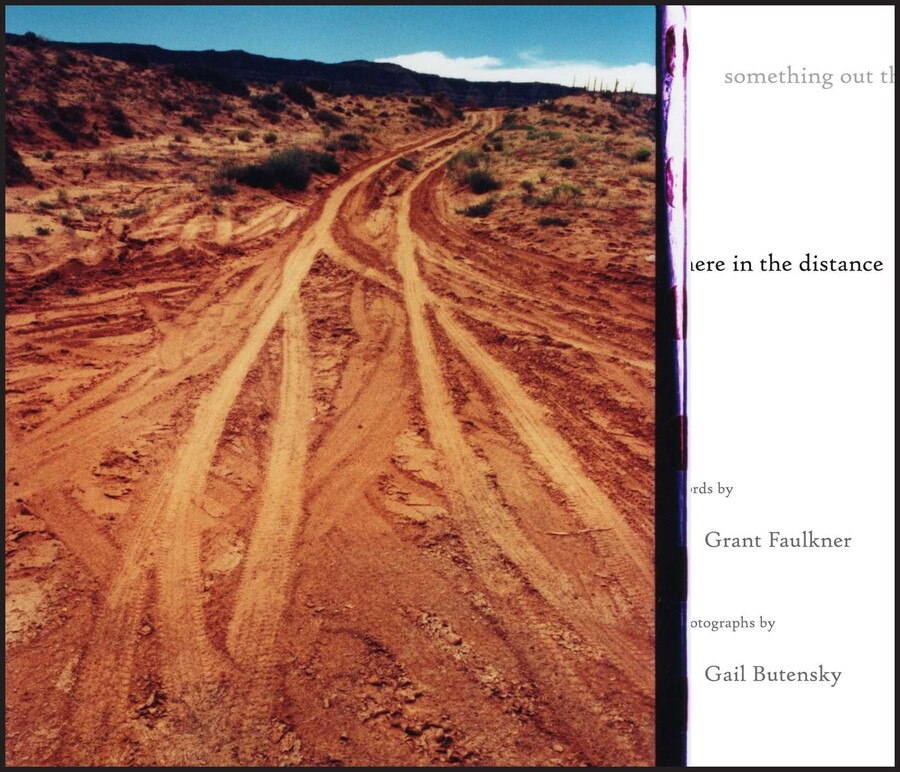
Grant Faulkner is the co-founder of Memoir Nation, the Flash Fiction Institute, and 100 Word Story, and an executive producer on the upcoming TV show, America's Next Great Author. His "flash novel," something out there in the distance, is a linked series of short-short stories that weave their way through photos by Gail Butensky. Find out which other fragmented work he's obsessed with and which novel made him cry more than any other book.

The Writer's Life

Reading with... Grant Faulkner


photo: Bart Nagel

Grant Faulkner is the co-founder of Memoir Nation, co-founder of the Flash Fiction Institute, co-founder of 100 Word Story, and an executive producer on the upcoming reality TV show America's Next Great Author. He has published several collections of stories and books on writing. His "flash novel" something out there in the distance (Unm Press) is a linked series of short-short stories that weave their way through photos by Gail Butensky.

Handsell readers your book in 35 words or less:

Have you ever read a novel whose stories flow from photos? A story that is a prose poem? A book that is like watching a film? Read something out there in the distance.

On your nightstand now:

The Use of Photography--Annie Ernaux and Marc Marie's book of photos and stories about their affair 20 or so years ago, translated by Alison L. Strayer. I love Annie Ernaux. I love books about affairs and love. And I love stories told with photos (as evidenced by my book something out there in the distance).

Rilke's Book of Hours: Love Poems to God, translated by Anita Barrows. I love his dreamy, searching writing, the way he writes to the questions, not the answers, in a melody of words.

Andrea Gibson's Lord of the Butterflies. I've been obsessed with them since they died last summer. Their writing, their life--their capacity to feel so deeply and express deep feelings in such an emotional yet unsentimental way.

Favorite book when you were a child:

I was an avid reader from the start. I wanted to be President of the United States when I was a kid, so I largely read biographies of Presidents when I was in grade school. Then I became captivated with the Little House on the Prairie books by Laura Ingalls Wilder when I was 11 or so.

I think the best art is art that you experience before you're supposed to, though. I "accidentally" read Crime and Punishment when I was researching a paper on crime for a class in the ninth grade. I didn't know who Fyodor Dostoyevsky was, but I was intrigued by his name. It was my introduction to sin in literature. My introduction to a godless world. I'm haunted by Rodion Raskolnikov.

So to answer your question, it's a tie between a biography of Ulysses S. Grant, the Little House on the Prairie series, and Crime and Punishment.

Your top five authors:

F. Scott Fitzgerald because I read him during a semester in France, the semester I decided to be a writer. I thought I'd be an expat writer living in glorious places, cavorting through many a drink, and writing novels. My life has sadly been more ordinary.

James Salter has been described as a writer's writer, and I learned the importance of rhythms and moods and contours from his sentences.

Denis Johnson is a writer whom many writers try to imitate but always fail. Menacing. Absurd. Funny. Tender. Desultory. Hallucinatory. Religious. Poetic. I still try to imitate him.

Sigrid Nunez is a writer whom you read to be with, to think with, as if you're taking a walk with her. So intimate, so wise.

Nathalie Sarraute focuses on capturing the "tropisms" of life: the spontaneous, subconscious, and fleeting internal movements that occur during human interactions. She has formed my aesthetic as much as anyone.

Book you've faked reading:

I've never faked reading a book, but I like to joke that almost every writer I know, including me, has a copy of Infinite Jest by David Foster Wallace on their bookshelves but has never read it. I no longer even plan to read Infinite Jest.

Perhaps a better answer is that The Savage Detectives (by Roberto Bolaño, translated by Natasha Wimmer), is one of my favorite novels, but I've failed to finish it in two attempts. I've only read the first half. It's an amazing first half of a novel.
Book you're an evangelist for:

I could easily say Nunez's The Friend, Johnson's Jesus' Son, Paul Bowles's The Sheltering Sky, or Malcolm Lowry's Under the Volcano, all of which I've given as presents innumerable times, but I'm going to go with A Lover's Discourse by Roland Barthes and translated by Richard Howard because I'm obsessed with thinking about love, which we should all think about more.

It's really a rejected lover's discourse. The book was spawned by the forlorn love letters that Barthes wrote to a man whom he had an affair with. The book is structured as a collection of 80 short chapters, or "fragments," each dedicated to a different type of amorous feeling, such as waiting or jealousy. He creates a piercing portrait of a lover's fevered consciousness.

Book you've bought for the cover:

When I first moved to San Francisco in 1989, it seemed that Kathy Acker books were everywhere, and her covers often featured the body, nude or seminude, reflecting her themes of female desire, power, and identity. The covers were daring and subversive and punk and brash. How could I not read her?

Book you hid from your parents:

I never had to hide a book from my parents, but there was one book I hid from myself. I bought the Necronomicon when I was a teenager because I was interested in the occult and mysticism, and this book cried out to me with a sinister siren's song at the Waldenbooks in the Merle Hay Mall in Des Moines, Iowa. Every time I went to Des Moines, I found myself looking at it, but too afraid to open its pages. Even after I bought it, I never opened it up. I was too scared of it.

I just Googled it, and I see it is a fictional book of spells and incantations from the horror stories of writer H.P. Lovecraft. I didn't know who Lovecraft was as a teen.

Book that changed your life:

The aforementioned Crime and Punishment very deeply immersed me in the complexities, contradictions, and darkness of the human spirit--and showed me how deep needs and obsessions can smother a person's more reasonable and generous side. I quit believing in God around this same time, and I haven't viewed life the same since then: everyone carries some sort of sin with them.

But on a more hopeful note, when I was 20, I studied in France and decided to be a writer, and one of the expat books I read was Ernest Hemingway's A Moveable Feast.

I am from a small town in Iowa, so the idea of being an author, living in exotic places, and dedicating all aspects of my life to my art was quite foreign to me. I read the book as a type of instructional manual to writing, and then I returned home and lived in a renovated chicken coop that summer and carried out Hemingway's creative process.

Favorite line from a book:

Sigrid Nunez said that all stories are about loss in some way, and I ponder this often.

In The Friend, she wrote, "What we miss--what we lose and what we mourn--isn't it this that makes us who, deep down, we truly are."

I loved her "trilogy on loss," comprised of The Friend, What Are You Going Through, and The Vulnerables.

Five books you'll never part with:

Just to add five more to the mix mentioned above--all of which I've reread many times:

Under the Volcano by Malcolm Lowry, which took me to Mexico several times.

The Stranger by Albert Camus, my first book by an existentialist.

Love in the Time of Cholera by Gabriel García Márquez, because it made me cry more than any other book.

The Sheltering Sky by Paul Bowles. I love his meditation and fascination with the desert, the ultimate Bowles metaphor. I love how the book shows what can happen when people are unanchored, drifting, elsewhere, not truly knowing where they want to be.

Open City by Teju Cole, because I love a story about a character walking around and noticing and thinking. The book uncovers layers of a city, layers of a traumatic personal and collective history. It opens and keeps opening.

Book you most want to read again for the first time:

Most of my transformative reading happened in my teen years, when books shaped all of my perceptions, thoughts, and dreams. Let's say Steppenwolf by Hermann Hesse for its dark mysticism, or On the Road by Jack Kerouac because nothing makes me happier than a road trip. I haven't reread either of these books because I don't want to blemish my teen impressions. I don't want them to disappoint me.


Book Candy
Rediscover

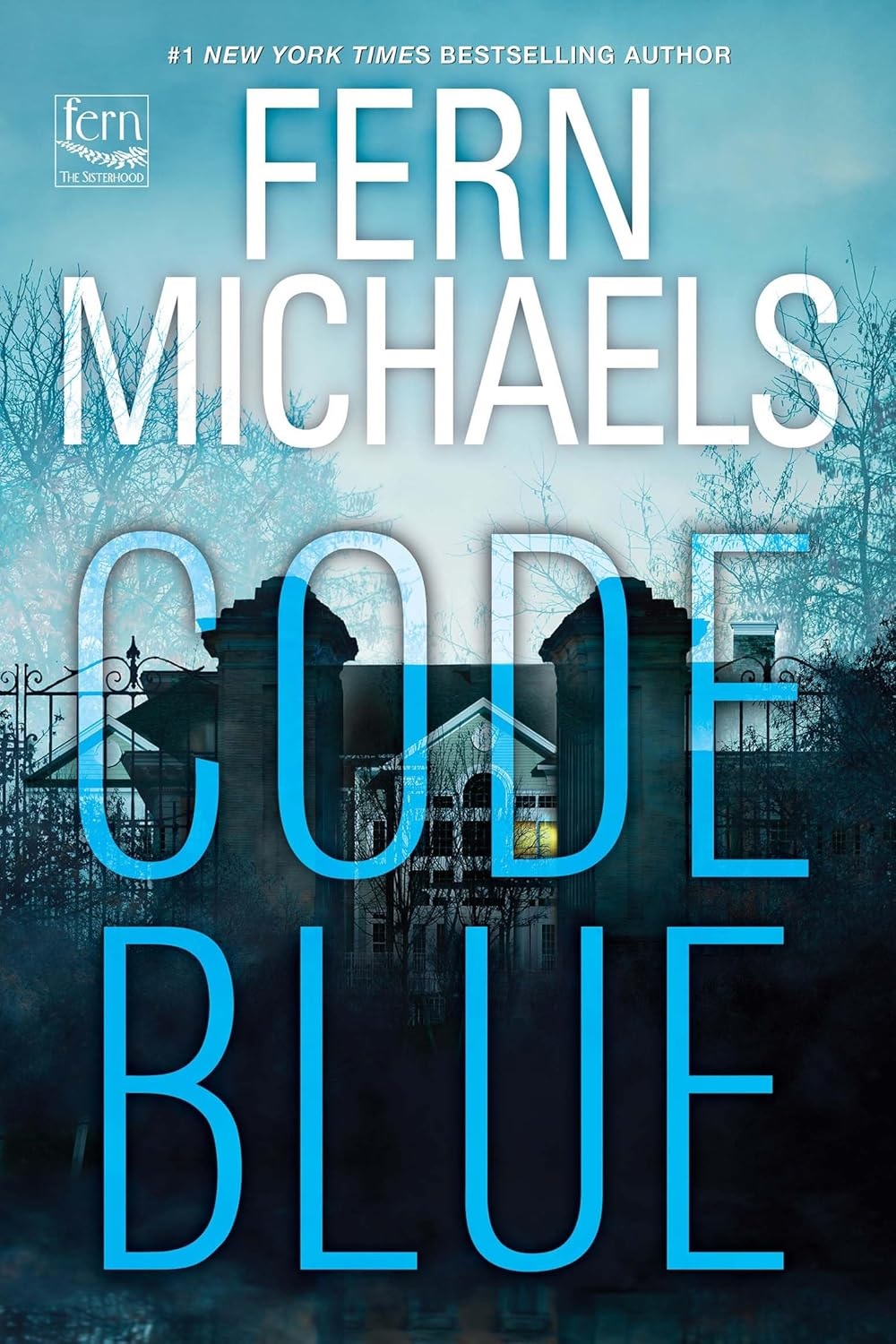
Prolific author Fern Michaels, "a mother of five in suburban New Jersey who responded to her husband's request to get a job by taking up writing, only to blossom into a bestselling author of more than 200 romances and thrillers," died last November at age 92, the New York Times reported. She sold an estimated 150 million books, according to Kensington, her longtime publisher, and was best known for the Sisterhood series, a collection of 36 romantic thrillers.

Rediscover

Rediscover: Fern Michaels

Prolific author Fern Michaels, "a mother of five in suburban New Jersey who responded to her husband's request to get a job by taking up writing, only to blossom into a bestselling author of more than 200 romances and thrillers," died last November at age 92, the New York Times reported. Michaels began her career writing with a partner, Roberta Anderson, but took legal control of the pen name (her real name was Mary Kuczkir) in 1989 and adopted it as her public persona in interviews.
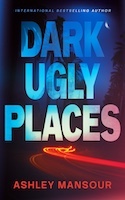
She sold an estimated 150 million books, according to Kensington Publishing, her longtime publisher. Her work has been translated into 20 languages. She was best known for the Sisterhood series, a collection of 36 romantic thrillers that began with Weekend Warriors (2003).

Michaels credited a steely resolve that allowed her to launch a writing career in her 40s: "When my youngest went off to kindergarten, my husband told me to get off my ass and get a job. Those were his exact words. I didn't know how to do anything except be a wife and mother.... Rather than face the outside world with no skills, I decided to write a book. As my husband said at the time, stupid is as stupid does. Guess what, I don't have that husband anymore." Although the couple never divorced, they separated in the early 1970s.

She met Anderson, another suburban mother, while working part time in market research. They chose their pen name because Michaels liked the name Michael, and had a huge plastic fern in her living room. The Times wrote that "the duo worked odd jobs, including cleaning clogged drains and taking door-to-door surveys, before publishing the first Fern Michaels novel, Pride & Passion, in 1975.... Two years later, they achieved a commercial breakout with Captive Passions."

"Fern's books became a safe place for women to find someone who not only understood what they were going through, but also celebrated them," said Esi Sogah, who edited several of her novels for Kensington. "She gave us a window into the world the way it could be, and showed us how to have a fun time doing it."

After she took over the pen name, Michaels continued her relentless pace for decades. Even into her 90s, she typically published four books a year. She recently embarked on a new series, Twin Lights, and published the first installment, Smuggler's Cove, in August. Code Blue, the 37th Sisterhood novel, was published in December, and several more books are scheduled for publication in the coming year.

"Is Fern Michaels a great writer? No," she wrote on her website. "She is however, one hell of a story teller. When people ask me what I do, I say, 'I scribble and tell stories.' It's a great way to make a living."

Powered by: Xtenit