

|
|
| Josephine Riesman | |
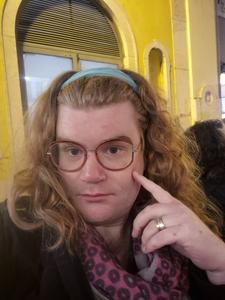
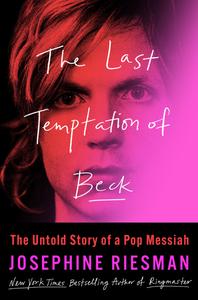
Josephine Riesman is the Portugal-based, U.S.-born authoress of the New York Times bestseller Ringmaster and the Hugo Award finalist True Believer: The Rise and Fall of Stan Lee. Prior to her book career, she was a longtime staffer at New York magazine, as well as a freelance writer for the Wall Street Journal, the New York Times, the Washington Post, the New Republic, VICE, and Rolling Stone. She lives with her partner, the writer/editor/cartoonist S.I. Rosenbaum, and their two cats. The Last Temptation of Beck (Atria; reviewed in this issue) boldly parses the influence of Scientology on the musician's life and career.
What's your favorite Beck album? (Mine's Mutations, which I discovered at my public library in high school, and whose stripped-down honky-tonk balladeering shook my understanding of the artist I'd only known for wackier upbeat tracks.)
I'm going to come across as a total snob here, but my favorite Beck album is one that was never formally released. In the early 2010s, Beck assembled some of his finest session musicians and touring players to gradually assemble an album of musical genius he was thinking of calling Rococo. For reasons known only to Beck, rather than release the three movements of this prog-rock epic ("I Won't Be Long," "Defriended," and "Gimme") as an LP, he just quietly dropped them as separate vinyl singles in 2013. No fanfare. No press rollout. There are streaming versions of two of the movements, but no stream of the full, 20-plus-minute "Gimme," which is what the whole damn project is building up to, anyway. Nobody paid attention and none of the songs became live staples. It's a goddamn shame. Thank goodness Beck has such a lenient policy toward piracy, because you can listen to a fan-assembled sequence of the three songs on YouTube and experience the glory. For now!
I can imagine researching and writing this book felt daunting and even foreboding at times. What drew you to this delicate subject, and do you have strategies for managing nerves and second-thoughts?
Oh dear, my nerves really needed to be managed on this one. And there were second, third, fifth, and 17th thoughts about many parts of the whole endeavor.
But to answer your first question, I was drawn to the story of Beck because I had been such a fan of his music in my youth and, like many other fans, had been baffled by the turn his life and art took at the turn of the millennium. I hadn't planned to ever explore that question in a book, but in 2022, a hot tip fell into my lap, and I suddenly saw the narrative forming in my head. I pitched the book and got it, but wasn't prepared for what I would find as I dug deeper.
I learned some very dark truths about Beck's life, especially about what was done to and around him as a minor. I wrestled mightily with the question of whether some of Beck's most personal moments were mine to tell. What I concluded was that if I didn't write about what I'd learned vis-a-vis those moments of vulnerability, his later moments of conflict wouldn't make sense. Context was essential.
For the record, I made extensive efforts to reach Beck and ask him about any number of things, from the very beginning of the process all the way up to the publication of the first serial, and he opted not to respond to anything.
Managing nerves was difficult, especially given that I fled my home country while writing this book, but having the world's greatest spouse helped a lot.
 How do you go about tracking down sources for this kind of project, and how do you build a rapport to help them open up?
I don't want to give away all my secrets, but finding initial sources wasn't too hard. I reached out to public and semi-public figures I knew had been close with Beck in the 1990s, through their representatives or contact pages. If there wasn't a public contact page or representative, I used Spokeo--a U.S. journalist's best friend for cold calls. If I reached them, I told them my goal: I wanted to write a book about the Gen X cultural revolution and what went wrong with it, as told through the prism of Beck's true story. I tried to be empathic with everyone I spoke to, while also remaining professional, and I always asked my subjects if they could introduce me to others who had been in the circle. I've done a lot of interviews in my 20-odd years as a journalist!
What was your favorite part of writing this book?
Gaining and maintaining the trust of my confidential sources. That's always a challenge, but if you can rise to it, you know you've done your job right.
Has the way you consume pop culture changed, given how your work takes you through some of its more difficult realities?
Sort of. I really do have to separate the art from the artist with everything now, because I know too much to ever have the default assumption that there's nothing morally objectionable about a great creator. You can always stumble upon something horrible that an artist said or did. You can't let that take the art away from you. You have to reclaim it, disclaim it, and then exclaim your own, improved version of it.
What advice would you give readers who might be grappling with unappealing news about a favorite celebrity?
Remember that you can learn just as much from a culture hero's mistakes as you can from their successes. Let their transgressions be an opportunity for personal reflection, and an interrogation of your own challenges as a person.Very often, an artist with regrettable, or even horrible, things in their ledger can put the best version of themselves into the art they create--and that best version can have a lot to teach a reader/viewer/etc. So can the worst version, by opposite example.
Why is culture writing important to you and who else's work in the field has inspired you?
Culture writing is important because culture is more or less all we have left. Everything is media, and media is culture. Politics is downstream of culture. There needs to be serious reporting on the horrors (and hard-won glories!) of the culture industry, or else we will ignore the troublemakers who then spill into the halls of power.
I am inspired by many culture writers, so forgive me for not naming them all, but here are a few deep inspirations, off the top of my head: Andrea Long Chu, Jessica Hopper, Dart Adams, Ellen Willis, Susan Sontag, Roger Ebert, Robert Christgau. --Dave Wheeler, senior editor, Shelf Awareness