


|
|
| photo: Sarah Witherington | |
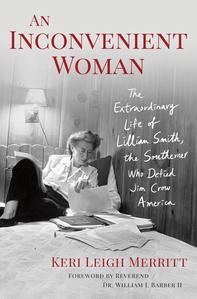
Keri Leigh Merritt is a historian and writer whose first book, Masterless Men: Poor Whites and Slavery in the Antebellum South, won both the Bennett Wall Award from the Southern Historical Association and the President's Book Award from the Social Science History Association. Her latest book, An Inconvenient Woman: The Extraordinary Life of Lillian Smith, the Southerner Who Defied Jim Crow America (St. Martin's Press; reviewed in this issue), is a revelatory biography of a white Southern woman who was a key figure in the early civil rights movement.
Lillian Smith has often been absent from the popular story of the civil rights movement. What first drew you to her, and why do you think her legacy became so obscured?
I was drawn to Lillian precisely because of her near erasure from history. I thought I had read every major Southern writer, and then (in graduate school!) realized I'd never heard of Lillian Smith. Her legacy was obscured in part due to her sexuality, but primarily because her philosophy was and is so threatening to the white supremacist status quo. By showing white Americans how racism injured them and their children, she changed the ways in which they understood and conceptualized white supremacy and segregation.
Tell us about the Laurel Falls Camp for Girls, which was a prime environment for her social vision. How did her work there influence her ideas on race and gender?
Lillian ran the summer camp her father started in Clayton, Ga., from 1925 to 1948. Serving as director, with her partner Paula Snelling as assistant director, Smith transformed the camp into a unique, life-changing experience. Every summer for two months, girls ages seven to 17 came from around the South to attend "Miss Lil's" camp. Some of the most prominent white supremacist families chose to send their daughters there knowing full well that the camp promoted integration and taught campers to view all people as deserving of honor and respect. Smith even tried to integrate the camp, and when that was unsuccessful, she invited local Black children over for events and meals with white campers.
Lillian Smith employed psychology and philosophy in her writing, showing that segregation and white supremacy hurt both races. Did Smith pioneer this application of Freudian theory to white supremacy in the South?
Smith definitely pioneered the fusion of Freudian psychology and Jim Crow (some of her main points are fascinating), particularly regarding sexual repression, attachment issues, and psychological resentment. But there were many others who used similar psychological frameworks at that time, even academics. Lillian was a tireless researcher and autodidact and would become almost obsessed with a field of study. If you look through her reading lists, you will see intricate, curated materials; it was as if she was preparing for doctoral exams in each subject. It's also important to note that her work was influenced by a group of (relatively) racially egalitarian sociologists at the University of North Carolina.
Smith balanced her criticism of the South with practical suggestions and solutions. What types of solutions did she offer fellow white Southerners to escape the cycle of hate?
Lillian Smith's first job was as a teacher, and she had total faith in the power of education. She believed that compassion and empathy could be taught and nurtured in each child. And during Jim Crow, she thought that breaking down the walls of segregation--having people get to know each other on a personal level--was the ultimate key to ending white supremacy. Furthermore, Smith was committed to fighting hate, in all its forms, with art. Creativity helps form and inspire social movements, and she believed that art serves as spiritual and psychological nourishment for activists.
 In her controversial novel, Strange Fruit, she explored taboo topics of interracial love and same-sex attraction. What could she say in fiction that she could not in nonfiction?
Smith had several manuscripts destroyed in the various fires at her house, including a novel called Julia that she worked on intermittently throughout her life. Julia plainly and explicitly revolved around lesbian relationships, and that was the main difference in her fiction and nonfiction: in fiction she had the freedom to write about sex and sexuality. As much as she wanted to be able to write similarly in her nonfiction work, she was always concerned about how her family would react, and she also wanted to protect Paula from any possible backlash.
How did Smith's sexuality inform her sense of justice and fairness? What message does her life lend to younger generations of LGBTQ+ people?
While a lot of Lillian's progressivism came from her charitable, empathetic father, her sexuality certainly added to her sense of justice and commitment to human rights for everyone. I argue that she and Paula lived relatively openly; friends and family knew the nature of their relationship but never addressed it by name. The little rural community they created with other LGBTQ+ couples was beautiful, and the two women certainly "mothered" and nurtured other younger gay artists and activists. Lillian's message would be: find your people, create your community, love and nurture and care for one another. As a quick aside, Paula was an essential part of Lillian's success and a talented writer in her own right.
A curious feature of Smith's progressive vision was her intransigent stance on Communism. How do you explain this?
Smith's three years as a teacher in Huzhou, China, in the early 1920s profoundly shaped her attitudes toward Communism, as she saw firsthand the violence it wrought. She always considered communism as anathema to democracy (much like her friend Eleanor Roosevelt) and wrote frequently about her views, particularly during the Cold War years. But that did not stop the FBI from investigating her as a Communist over the course of decades: her 134-page file was longer than John Steinbeck's. She also acted several times to help protect her Black friends, including Mary McLeod Bethune and Paul Robeson, from charges of Communism.
Most of Smith's life work (manuscripts and letters) was destroyed in a 1955 fire--how did this impact your research?
Thankfully, Smith was so prolific there were still plenty of materials to work with! Most of my research is on antebellum America, often with non-literate people, so having tens of thousands of archival documents is an embarrassment of riches to me. The hardest part was wading through everything and figuring out the most important parts to tell. Smith had decades of correspondence with hundreds of people, some of the best artists and activists of the mid-20th century. She also had a decade of magazine publishing, two years of weekly columns, and seven books. Finally, during her 13-year battle with breast cancer, she made sure her biographical materials were well preserved. Once Smith passed, Paula dedicated the rest of her own life to cataloguing Lillian's papers and establishing archives at both the University of Florida and the University of Georgia.
What do you hope readers will come away with after reading An Inconvenient Woman?
For years we have had books telling people what NOT to do, so I hope this serves as instruction and inspiration. Everybody needs heroes, and uncovering instances of Americans who have put their backgrounds and privilege aside in the fight for freedom is always important to tell. May Smith's legacy remind each of us that we have the power to make the world a better place, even in some small way. --Peggy Kurkowski, book reviewer and copywriter in Denver