

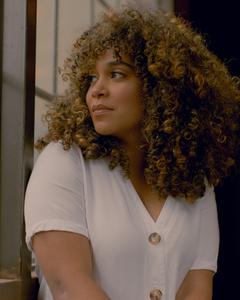
 Elizabeth Acevedo was the 2022 Young People's Poet Laureate and is the author of multiple novels, including The Poet X, which won the National Book Award for Young People's Literature, the Michael L. Printz Award, the Pura Belpré Award, and the Carnegie Medal. Acevedo is a National Poetry Slam champion, and she resides in Washington, D.C., with her family.
Anger Is Only a Shadow (Quill Tree Books; reviewed in this issue), Acevedo's fourth title for young adult readers, introduces Lil, a Black teen released from a juvenile detention facility with an ankle monitor. Lil struggles with impulse control but knows that she must help her older brother, who is experiencing the onset of mental illness.
The parents in Anger Is Only a Shadow are present and fiercely supportive of Lil, which is so refreshing in YA.
Yes, that definitely hearkens back to having parents who were all up in my business to the best of their ability. They were immigrant parents with strict standards, so I wasn't able to express myself quite the same way Lil can talk to her parents, but I fundamentally don't understand young adult novels where the parents aren't present and their involvement isn't part of the story's scaffolding. Even when I write parents who are absent, I build it into the reality of the character as something they have feelings about.
Lil makes clear she knows when to be soft and when to be "brick-built," but she is tender so often, wiping her baby sister's face with her sleeve or helping her ailing abuela look for something that doesn't exist. How did you decide to lean into that gentleness?
Initially, Lil was a tough character for me to get close to. I understood a lot about her, but I couldn't always understand her impulses, and it created distance as I was trying to write her. When I began fine-tuning her reactions to the vulnerabilities in other people, I was able to find parts of her I hadn't seen before. She's a caretaker, she's highly observant, she doesn't need to be told the needs of others to interpret them, and she's inherently decent. Those discoveries helped me round out a character that could easily be described as a hothead, rash, inconsiderate. She can be those things, but those negative qualities aren't the whole of her.
Lil's mom tells the judge that what Lil needs is "more assistance, not more isolation." Do you see incarceration like what Lil experiences as a flaw in the criminal justice system?
I can think of very few examples where isolation and exile are beneficial to the human spirit. We are social beings who suffer greatly when forced into loneliness. And when societal expectations enforce isolation and exile on someone, what we are saying is that we want to undo that person's spirit. How do they practice being human in lieu of being in community with others?
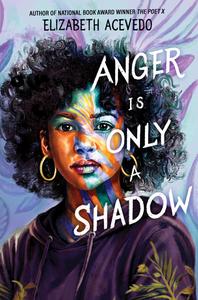 That danger of isolation is mirrored in how Lil's parents want to give her brother, Aldwin, space even as he exhibits worryingly uncharacteristic behavior. What made you decide to show this kind of response?
One of the hardest things about deeply loving someone in the early stages of mental illness is that the choices to provide help are all terrible. Often, you either have to revoke someone's agency by having them committed, or you have to convince them that they aren't relating to the world in the way they once were, which requires patience, understanding, and the ability to converse about something that few of us ever practice talking about: mental health. I wanted to show how Lil's parents felt unraveled by not knowing how to show up for their son. I wanted to show how deeply they hoped against all hope that if they gave it enough time it would simply... stop? Go away? Return to normal? It can be so hard to feel helpless as a parent.
It has been reported in multiple academic journals that schizophrenia tends to be overdiagnosed in Black men. How do you make heads or tails of this?
It's such a difficult landscape to navigate. Especially because its overdiagnosis doesn't mean that the symptoms aren't indicative of a different illness whose symptoms would be relieved by (very successful!) treatment. The state of mental health in the U.S., especially for Black people, is tragic. It's so hard to find answers, and then when you find answers, they are so often convoluted.
On a date with a boy, Lil asks if his foster parents "know what kind of girl I am?" It speaks to how she knows the world has decided to define her based on her mistakes and their arbitrary consequences, even though she believes it shouldn't. Why was this battle important for you to show?
In his memoir, Just Mercy, Bryan Stevenson states, "Each of us is more than the worst thing we've ever done." When I first read that, I had to sit with it for a long time. But I do think that the average person, with limited societal power, despite having done harm, deserves dignity, respect, and grace. This belief guides how I wrote Lil. What the legal system, her parents, and her community tell her is the "right" way to be does not always match her internal compass, but it's important for her to establish her own code of ethics around rightness. And she shouldn't be solely defined by how she fails as she figures it out.
Lil says "poems aren't small--they simply carry weight differently." You included a lot of poetry from Lil throughout the novel.
Yes. Lil's poems are windows into a different side of her. They provide information she probably wouldn't offer otherwise but can access because she's responding to the "Where I'm From" assignment from the poetry workshop she attended while detained. It gives her a different doorway into herself, and the reader gets to see the weight of her hopes, her beliefs, and her memories in ways they otherwise might not have.
You've also beautifully woven Salvadoran, Dominican, and Taíno myths into the novel.
That was to underscore what was happening in the story. Incarceration is a response. How we treat mental illness in this country is a response. Historically, different communities had different approaches for how to address someone in their culture causing harm to themselves or to the community. And so I wanted to highlight a family that was deeply rooted in different forms of resistance, community building, inclusion, and love for oneself and one's family.
What was it like narrating the audiobook?
I love narrating my own work! I was really in a groove with this novel, and the audio rendering shows that. For a book that really considers storytelling in many forms, I'm so happy I could offer a form of oral storytelling, too. --Samantha Zaboski, freelance editor and reviewer