

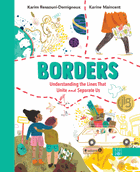
French author Karim Ressouni-Demigneux and artist Karine Maincent (How to Survive on a Desert Island) collaborate on Borders: Understanding the Lines That Unite and Separate Us, a nonfiction middle-grade picture book that insightfully blends historical, sociological, and cultural explorations from around the world. Irish polyglot Johanna McCalmont (The Best Daddy of All) translates.
Modern humans began wandering some 100,000 years ago and, eventually, Homo sapiens migrated out of Africa 60,000-70,000 years ago. The only borders back then were natural, like seas, mountains, glaciers, deserts; as our ancestors wandered, they adapted remarkably to all manner of environments and climates. Humans were mostly nomadic until about 10,000 years ago, when settlements called city-states emerged. So grew the need for protection--walls, moats, and other dividers, as well as fences and garrisons. Kingdoms and empires followed, while colonial expeditions displaced and destroyed Indigenous populations. Conflicts and wars keep borders constantly changing: border laws differ for the sea and for space, while borders have created the need for checkpoints, time zones, passports, and visas.
Ressouni-Demigneux, who has traveled and lived in Morocco, Brazil, and China, among other places, deftly exposes the arbitrariness of borders with solid examples. In a section labeled "Temporary Borders," he explains how possession of Alsace and Lorraine has gone back and forth repeatedly between France and Germany; discusses buildings purposefully built to enter in one country and exit into another; and describes NGOs that regularly work across borders. Maincent's art reflects a childlike quality throughout, with cartoonish and diverse characters in whimsical, charming settings, creating inviting spreads ready for easy exploration. Helpful back matter includes a glossary and further resources. --Terry Hong