

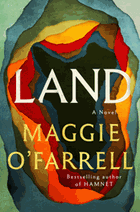
The simplicity of its title masks the depth of insight and emotion that makes Maggie O'Farrell's novel Land such an encompassing reading experience. This story of a humble 19th-century Irish family is both a microcosm of the country's travails and a timeless exploration of themes of love, abandonment, loss, and grief.
Opening in 1865, a little more than a decade after the end of the Great Hunger, Land focuses on the family of Tomás, a surveyor and skilled cartographer who supports his family on commissions from the despised "scarlet-jacketed soldiers" engaged in a massive mapping project of his native land. Tomás is determined that his maps "will bear an account of what happened, what was lost, if it kills him."
In the midst of one of his expeditions, he experiences a shattering trancelike state after drinking from an ancient spring. When he recovers, he uproots his family--mapmaking assistant son Liam, wife Phina, daughters Enda and Rose, and soon-to-be-born son Eugene--from their Dublin home and resettles them on the remote peninsula that transformed him.
Over the next two decades, as they pursue their outwardly simple existence, there are deaths and departures--Liam first to Rome and then India as a Jesuit priest, and Enda, a headstrong, talented fiddle player, to Canada--amid moments of tenderness and violence. In Land, Maggie O'Farrell (The Marriage Portrait) has chosen to record her representation of Irish life on a much larger canvas than she did the world of William Shakespeare in Hamnet, but the same qualities of empathy and grace she displayed in that beautiful novel reappear here in abundance. --Harvey Freedenberg, freelance reviewer