

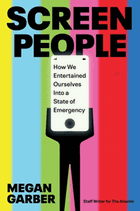
Anyone who has felt a twinge of regret when their smartphone reminds them how much time they've spent looking at a screen the previous week will appreciate Screen People, Megan Garber's well-informed account of how electronic devices have come to dominate modern lives.
Garber, a staff writer for the Atlantic, acknowledges at the outset her considerable debt to '60s media theorist Marshall McLuhan and his aphorism "the medium is the message," and to scholar and cultural critic Neil Postman and his 1985 book, Amusing Ourselves to Death. Now, instead of functioning as passive receivers of content, "we are both actors and audiences, producers and consumers, directors and extras in the show," she writes. "We become one another's critics. We become one another's fun. We defer to entertainment as a value system." Writing from the perspective of a cultural journalist who grew up in the 1980s and '90s, and emphasizing breadth, Garber supports her argument with timely material drawn from diverse sources, including news, politics, social media, artificial intelligence, and reality television.
Garber recognizes that powerful economic, political, and, above all, technological forces drive these fundamental social changes, and it seems an individual can do precious little to resist their power. Nonetheless, she concludes her book on a cautiously optimistic note. "We will decide. We will determine what it means, in the end, to live among screens," she says. The challenge, in her view, is to decide how society would like to shape itself in that decision. Armed with some of the insights she shares, perhaps the task of meeting that challenge and reclaiming essential humanity will be less daunting. --Harvey Freedenberg, freelance reviewer