

|
|
Scott Kurtz is an Eisner- and Harvey Award-winning cartoonist who helped pioneer webcomics with his daily feature PvP. Kurtz can be found in the Pacific Northwest, where he occasionally leaves his studio to enjoy the dog park or visit his family.
Emily B. Martin splits her time between working as a park ranger and as an author and illustrator, resulting in her characteristic eco-fantasy adventures. An avid hiker and explorer, she lives in South Carolina with her husband and two daughters.
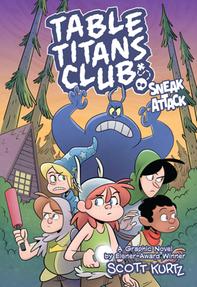
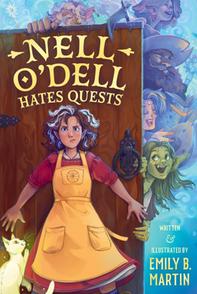
The second title in Kurtz's middle-grade Table Titans Club series, Sneak Attack (Holiday House), revolves around five friends spending their summer at a live-action roleplay camp. Martin's middle-grade fantasy Nell O'Dell Hates Quests (Candlewick) features a reluctant adventurer who works at her family's inn serving half-giants, fairies, and fauns. Here, Kurtz and Martin talk D&D, LARPing, their fantasy favorites, and old-school mass-market fantasy covers.
Scott Kurtz: I was introduced to Dungeons & Dragons in the fifth grade. Rainy days were my favorite because that meant indoor recess, which was usually spent playing D&D and drawing. In Table Titans Club: Sneak Attack, the club spends the summer at a role-playing camp. Those didn't exist when I was a kid; otherwise, I might have felt differently about being outdoors.
Emily B. Martin: For me, nature and magic go hand in hand.
Kurtz: D&D didn't just introduce me to fantasy stories; it introduced me to storytelling itself. World-building, character development, and plot hooks. Gary Gygax and Dave Arneson lifted elements from Tolkien and Robert E. Howard to turn their tactical combat game into a fantasy role-playing game. I suppose it's ironic that the game led so many of us to the literature that inspired it, rather than the other way around.
Martin: I love that about fantasy--there are so many on-ramps. Even though you, Scott, came to it through RPG and I came to it through Tolkien and folklore, we wound up in very similar places. We both use the building blocks of classic fantasy to explore themes of friendship, belonging, and the ordinary bravery required by everyday life.

|
|
| Emily B. Martin (photo: Scott Thomason) |
|
Fantasy lets me write more earnest characters than other genres. When I write in real-world settings, I often shave off some of the wonder--after all, people can only be so starry-eyed if they're battling rush-hour traffic. But the fun comes in for a story like Nell O'Dell Hates Quests when I start adding some of that jaded attitude back in, and it becomes 100 times funnier. Sure, that mage conjuring golden light at table five is one of the most powerful beings alive, but he also asked Nell to make his broccoli-cheddar soup dairy-free, and she doesn't have time for this right now.
Kurtz: I think fantasy is so appealing to me because it has a long tradition of letting readers explore truth at a mythic distance. It gives you the freedom to take complicated, sometimes uncomfortable, and deeply human ideas and wrap them in dragons and magic so readers can approach them safely. I know any genre is capable of this, but there's something ancient about fantasy that seems to be baked in the DNA of every culture. I mean, there's gotta be a reason the first bedtime stories we hear usually start with "Once upon a time."
Martin: Yes! Both of our stories lean into RPG tropes rather than trying to subvert or transcend them. Why did you want to acknowledge and embrace those tropes instead of avoiding them?
Kurtz: For me, it's about nostalgia. It's a way of recapturing that feeling I had as a kid sitting around a kitchen table and creating worlds with my best friends. Rolling dice, snack foods, and arguing over rules is as much a part of those memories as the heroes we played and the quests we embarked on.
 |
|
| Scott Kurtz | |
You incorporated those tropes brilliantly into Nell's world, making them a metaphor of consumer culture. Questing is an economic driver and marketing ploy. So good! I'm nowhere near as clever.
Martin: Not true! Combining RPG tropes with summer camp culture is such a great marriage of halcyon memories. I know my time at summer camp always carried a veneer of fantasy. I also think the clear skill classes RPG builds on are very appealing to young readers, who are often looking for ways to express their identities. With Nell O'Dell Hates Quests, I got to build a world around those well-defined identities and then have Nell ask, "But do we have to do it like this?"
Kurtz: Both of our books also feature tension between a reluctant quester and a reckless one. What about that dynamic speaks to you?
Martin: For me, it creates this beautiful push-and-pull that permeates the whole story, which can help juice up a sagging plot. It also gives me ample opportunity for character development at the end of the book, when both characters finally recognize the value of the other's opposite approach.
How about you? In Table Titans Club: Sneak Attack, we wonder if the gung-ho attitudes of Val and Midge will launch this quest into new chaos, or whether the cooler heads of Kate and Nell will prevail. And it opens possibilities for banter and unexpected solutions, like when practical Kate gets Val and the others through the minotaur's maze by following the "right-hand rule."
Kurtz: It was a way for me to create conflict without making anyone an outright villain or antagonist. Friction is fuel when it comes to storytelling. Plus, it's just fun to see characters who refuse to be anyone else but themselves, no matter what trouble it causes. Nell is a cynic, and Midge is a believer. Val wears her heart on her sleeve, and Kate hides hers behind her popularity and status. It opens all kinds of avenues to explore as they interact and learn from each other.
Martin: Exactly. So, we're both artists. Fantasy novels and classic fantasy illustration have a storied history. Did those illustrations shape your imagination?
Kurtz: I remember the painted covers of all the fantasy mass market paperbacks I read as a kid. Dragonlance, Xanth, Dragonriders of Pern. They're burned in my brain. I can tell you which cover my copy of The Hobbit had. The same goes for the covers of my Player's Handbook and Dungeon Master's Guide.
Martin: Same! Those paperback covers were some of the earliest inspirations for my art subjects and style, and they influenced how I pictured fantasy worlds on a macro level.
Lately I've been digging into the historical foundations of things like clothing, travel, and castle construction to understand why visual fantasy tropes emerged as they did across so many of those influential illustrations: the folk-culture revival in the '70s pulling from the troubadour style of the early 19th century pulling from the medieval period. It's very fun, and it gives me a better understanding about how and why my worlds look a certain way.