

|
|
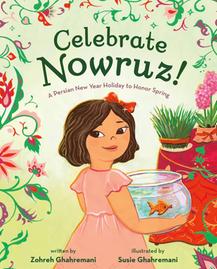
Zohreh Ghahremani is an author and poet whose work is influenced by her experiences as a Middle Eastern immigrant. Formerly a children's dentist and professor, Ghahremani now lives, writes, and prepares an elaborate haft-seen each year in San Diego, Calif. Celebrate Nowruz! (Godwin Books) was illustrated by Ghahremani's daughter, Susie Ghahremani, and features three generations preparing for Nowruz.
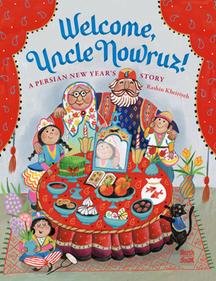
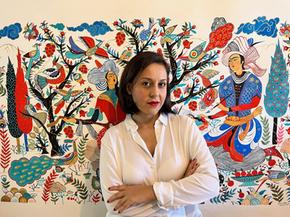
Rashin Kheiriyeh is an author/illustrator, animator, and painter who has more than 90 children's books to her credit. Originally from Iran, she now lives in Washington, D.C. Welcome, Uncle Nowruz (NorthSouth Books) is a retelling of a Nowruz folktale.
Here, the authors discuss the celebration of the Iranian New Year, the haft-seen (a centerpiece made of seven symbolic items that all begin with the letter "S"), and their excitement about bringing the spring solstice observance to children in picture book form.
Rashin Kheiriyeh: I loved Nowruz when I was a kid in Iran, and still love and celebrate it in America. The ancient Iranian New Year tradition refuses to be forgotten, even oceans away. Right?
Zohreh Ghahremani: Fifty years ago, no one in the United States even knew about it. I remember hearing Ken Davis on NPR saying that no one celebrated it here. So I called the station and shared what I knew about the millions of people who celebrate. That's when I decided: it is up to each Iranian to make sure that the world learns about the beauty of this day. My children, who were born and raised in the U.S., each have their own haft-seen! But I wonder how much of this beautiful heritage will be passed down to the third generation. This is why I wrote Celebrate Nowruz!--for the future generation.
Kheiriyeh: But things have changed! In my town, Washington, D.C., the city celebrates spring and they have the Cherry Blossom Festival. It's beautiful, and set up around town (including at the Smithsonian Museums) are haft-seen tables, the Nowruz decoration. It's heartwarming. We have to make sure to feed the right things to curious little ones around the world.

|
|
| Zohreh Ghahremani | |
Ghahremani: I have lived here a little over 50 years and gave up my profession to become a full-time writer. I want my grandchildren (I have four of them) to learn about this glorious heritage that we pass to them, and I want the world to know that Nowruz isn't simply an Iranian tradition--that several other nations celebrate the vernal equinox exactly at that same moment.
Kheiriyeh: I moved to New York in 2011, and gathering with family is not the same. I miss the tradition of visiting grandparents first and then the rest of the family members... and then everyone would revisit you one by one for the rest of the two-week holiday. And Persian sweets and candies! I miss them too. Nowruz parties are the best.
Ghahremani: Yes, the family gatherings! Although I hear they are not the same in Iran anymore, either. As for me, it is a lifetime habit to re-create what I miss. I have found pleasure in learning to bake all the cookies, and I have created aunts and uncles out of close friends for my children to visit at Nowruz. And every year, I put my heart and soul into making sure our entire family gathers around a haft-seen that is better than the year before. What I miss is Iran the way I remember it--and that I only miss because it can't be re-created.
 |
|
| Rashin Kheiriyeh | |
Kheiriyeh: That's so lovely. I think children enjoy knowing more about the Nowruz table setting through the haft-seen: it's kind of like a game, finding and collecting seven items in the house that start with the S sound or the letter S in Persian. Like sib means apple, sabzeh means sprout. Do you grow sabzeh every year by yourself?
Ghahremani: Yes, I do--not just one, but more for anyone who is unable to grow my best-in-the-world lentils! I agree that children love learning about getting the items for the haft-seen together--in Celebrate Nowruz!, that's the main challenge. Ariana's mom is away and she has to put it together with her dad. I also mentioned the visiting priorities: that we visit elders/grandparents first.
Kheiriyeh: I thought it would be nice to show readers that Nowruz is an old tradition, and it doesn't have anything to do with religion. It's a New Year celebration in a perfect time of the year: the first day of spring. So different people from different beliefs celebrate it. For Welcome, Uncle Nowruz, I used the story of Uncle Nowruz and Nane Sarma, which was one of my favorite folktales when I was little. Uncle Nowruz is the messenger of spring and Nane Sarma is a winter grandma. It's a love story in my opinion. And I thought I could explain the tradition through their story in Persia. Of course, I adapted it and I added some children to that story, who help the lovers meet each other for Nowruz. Can you guess the ending?
Ghahremani: I wasn't familiar with the story. I had to learn about it, and I like that you see it as a love story. I see Nowruz as a universal day: If there were no calendars, where would the world begin their year? To me, a year begins with spring. My children grew up believing we were partly celebrating Mother Nature's birthday. I wish the world could be more appreciative of the gifts nature gives us and could acknowledge this day as one worthy of celebration!
Kheiriyeh: Absolutely. You're right--it is a journey from winter to spring, and at the end the lovers cannot meet because winter and spring always chase each other. One arrives just as the other leaves. But it's important that they are hopeful to meet up next year. Uncle Nowruz leaves a flower in winter grandma's hair, because she fell asleep after setting up the Nowruz haft-seen table and once again missed his visit. They'll meet, even if it isn't today. Fingers crossed!
Ghahremani: That is such a beautiful story. You have a great imagination! What is your favorite part of Nowruz?
Kheiriyeh: My favorite part is the Festival of Fire called Charshanbeh Souri. It's a fun party. Children and adults jump over bonfires and with each fiery jump, dreams take flight. I love the idea of making a wish and jumping. Recently I added a tradition myself, where I would write down the bad feelings on a piece of paper and then I would throw it in the fire to remove them from my soul and body.
Ghahremani: I'm going to borrow that! I love that our holiday is a new beginning where we start with a clean home, new clothes, pure and kind thoughts... we forgive those who did wrong and reach out to the loved ones we have not been in contact with. In general, we believe this new year is the beginning of something good and that things can change. The optimism of the moment is what I appreciate the most.